
Hands on Car Control Exercises
The Panoz Performance Driving School offers half-day, one and two day programs for individuals and groups. All of our programs begin with classroom sessions emphasizing the vehicle dynamics theory behind performance driving followed by specific exercises designed to put the theory into practice. Based on the curriculum objectives and the time available, the hands-on driving elements of the course would be made up of exercises such as:
Skid Pad
Skid control and recovery is taught on a wet, circular skid pad. Students, riding with an instructor, are put into loss of traction situations and practice recovery techniques. Regardless of whether the front or rear of the car loses grip first, students focus their eyes, hands and feet on the correct recovery movements to regain control of the car.
Slalom
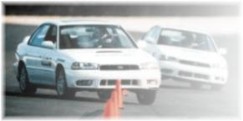
A simple slalom course, snaking through a straight line of cones, provides a fantastic opportunity to understand and feel the steering effects on a vehicle due to deceleration and acceleration weight transfer. The slalom exercise reinforces the requirement that, when near the vehicle's limits, a driver must be very smooth with control inputs and that patience and sensitivity on the pedals can build speed and control.
Finesse Course
A low-speed slalom exercise, the finesse course provides a direct, visual reinforcement to the student of the weight transfer effects of a driver's feet and hands. A ball placed in a large bowl on the hood of the student's car moves forward, backward and side to side based on where the student is moving weight with steering, acceleration or braking. The idea is to keep the ball moving smoothly and keeping it in the bowl as the low-speed slalom is negotiated.
Precision Course
A large percentage of accidents happen in low speed situations in parking lots or in one's own driveway. With this in mind, the Precision Course was designed to practice the situational awareness and spatial concepts behind backing, turning and negotiating tight corners at idle speed. The student enters a very tight course where they must make full steering lock turns, forward and backward, while demonstrating a knowledge of where the edges of the car reside.
Lane Change
Most accident avoidance situations involve more than braking hard in a straight line. Avoiding road debris or another errant driver usually entails an aggressive change of position on the road, changing lane or seeking an "out" to avoid an accident. In this split-second, lane change training pays off. Students drive into one of three possible guide lanes at cruising speed when two of the lanes become "blocked" by green to red light indication. They must decide the correct lane choice and then perform an aggressive lane change to a stop in the clear lane. Feedback from students has indicated that this exercise is one of the most difficult and important to master. Each run is critiqued by an instructor who is running the lane lights and watching the student's every move.
Threshold, Trail and ABS Braking
A vehicle can stop most efficiently when its tires are still rolling but on the "threshold" of locking up and skidding. Learning to use Threshold Braking techniques provides a driver with a powerful tool in accident avoidance and/or performance driving. Under the watchful eye of an instructor, students accelerate to speed and then practice threshold stops. Emphasis is placed on sensitivity to wheel lock-up, smooth brake pedal modulation and retention of directional control. This control is also put to the test with trail braking exercises, in which the students threshold brake and turn at the same time. While the use of an ABS-equipped car will help an untrained driver in most braking situations, the aforementioned exercises are performed without ABS. For completeness, however, students have an opportunity to drive an ABS-switched car and feel the difference back to back in a panic stop situation.
Autocross
As a fun and fast final exam, we use our autocross course to let the student piece together his or her braking, turning and skid control skills. A scaled-down racetrack lined with cones, the autocross course puts a student in an adrenaline-charged situation with the vehicle at its limit. It's a great way to have fun and demonstrate a blending of the skills taught during the day. Of course a little friendly competition never hurts either!
The Exercises